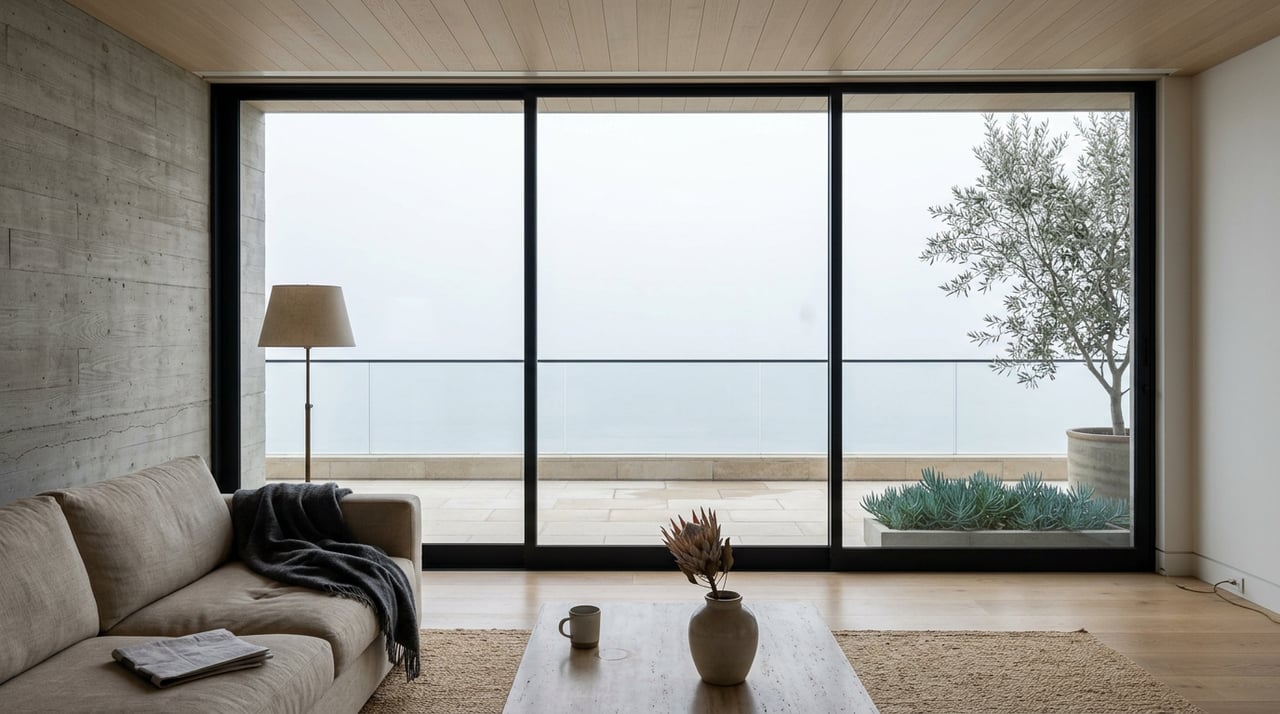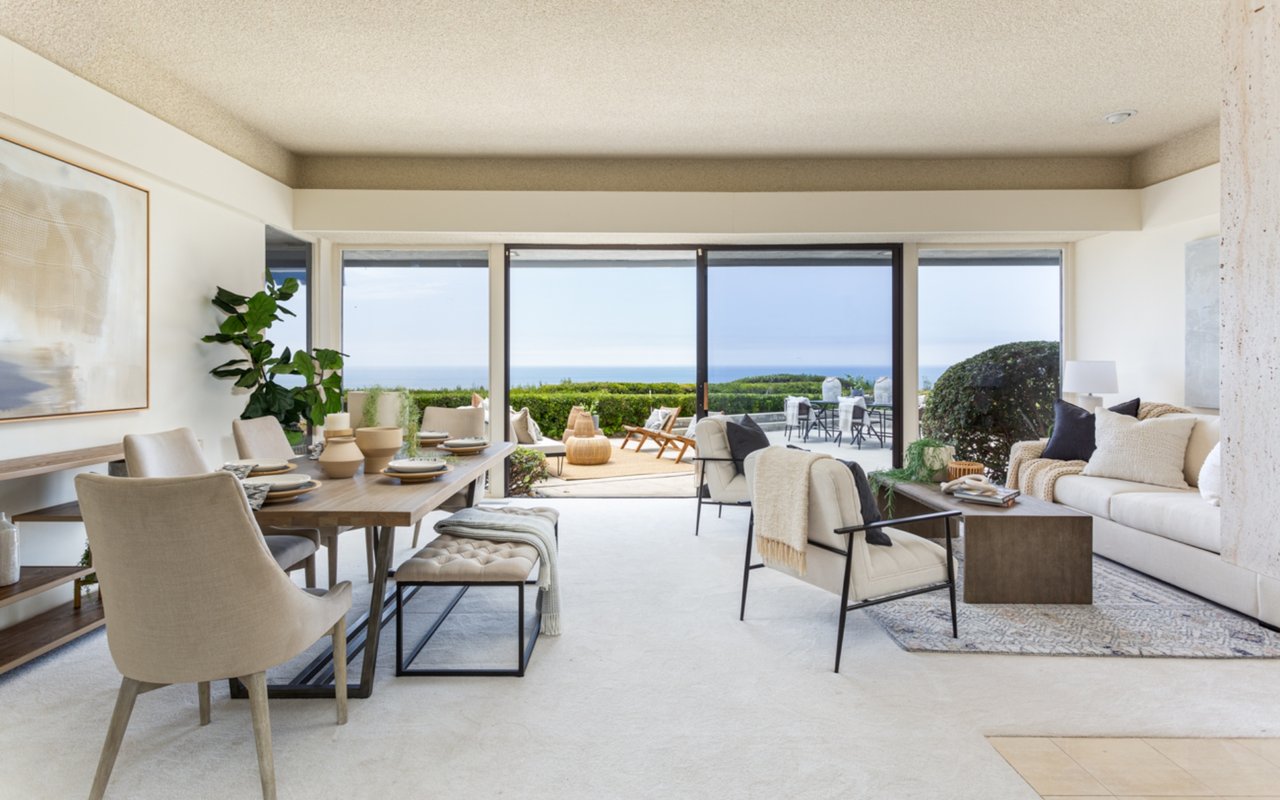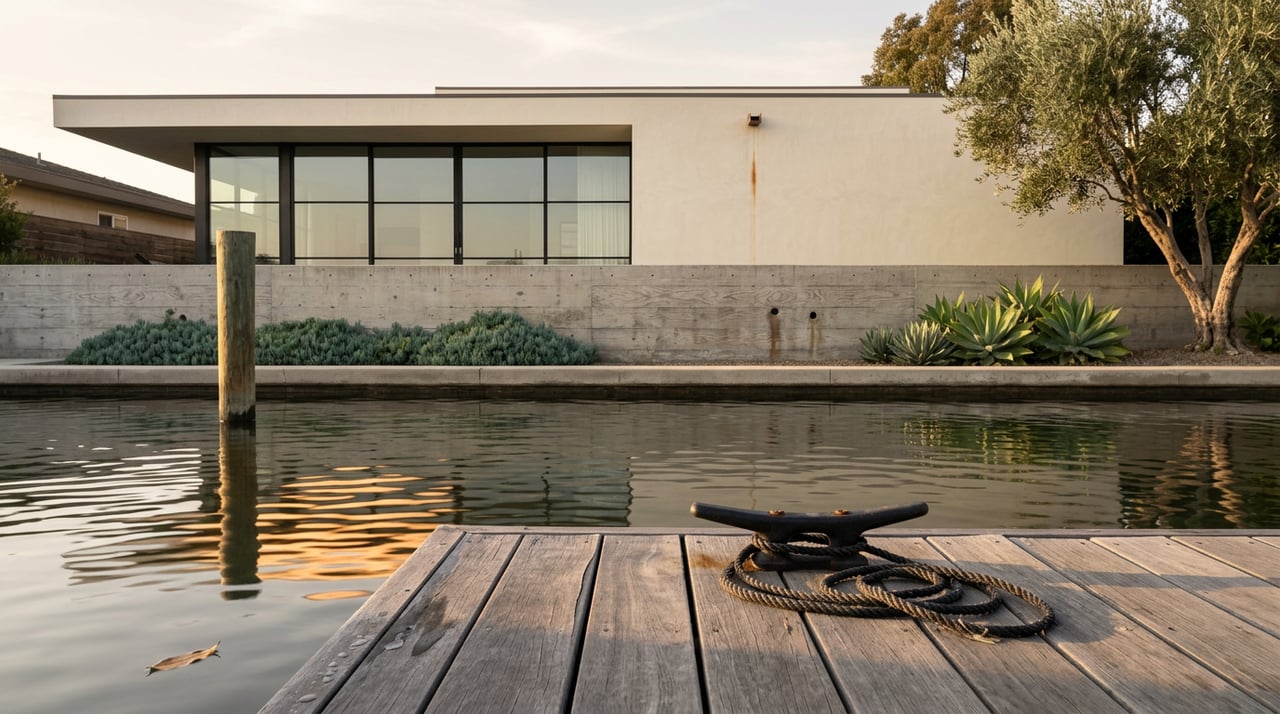
Two houses on the same Newport Beach street, same square footage, same year built, same finish level. One sells for a number that makes sense against the comps. The other sells for a number that doesn't, and the difference has nothing to do with the house. It's sitting in the water behind it.
That's the piece of the Newport Beach market that doesn't show up on a portal listing sheet, and it's the reason the citywide median tells you almost nothing about what you'll actually pay on the bay. If you're comparing Newport Beach to other coastal Orange County neighborhoods right now, the number you've already seen, a median closing price of $3.4 million over the trailing six months through August 2026, is the least useful figure you'll encounter. The useful figures live in the paperwork.
Your deed stops at the bulkhead. Your permit starts there.
Most buyers assume that a waterfront home comes with the water. In Newport Harbor, it usually doesn't. The land beneath the bay is public tideland, held in trust for the State of California and managed day to day by the City. What actually conveys with a bayfront home isn't ownership of the dock, it's a pier permit, a revocable right to maintain a private structure on public trust land.
The harbor is not a small system running on this arrangement. Newport Harbor carries more than 9,000 recreational vessels across roughly three miles of waterfront, and the City administers over 850 permitted residential piers along that shoreline. Every one of them sits on public land. The permit is the asset. The house is almost incidental to it.
This is why the same street can produce wildly different outcomes at closing. A permitted pier with clean history behaves like a scarce, transferable right. A property without one, or with a lapsed or contested permit, is selling a promise that the buyer will have to go earn from the Harbor Commission after close, on the Commission's timeline, not the buyer's.
The number that actually decides how much boat you can own
Ask a Newport Beach seller how big a boat their dock can hold and most will describe the dock. The real answer lives in a pair of federally established lines: the bulkhead line and the pierhead line. The distance between them is fixed by an act of the United States Congress for Lower Newport Bay, and it cannot be changed by the City, the County, or a homeowner's association. It can only be modified by another act of Congress.
That gap is what determines how far into the water a private structure can extend and how large a vessel it can accommodate. A parcel with a 40-foot gap between its bulkhead and pierhead line and a parcel with a 75-foot gap are not comparable waterfront assets, even if the houses on them are identical and the frontage measurements match on paper. One can berth a modest day boat. The other can hold something meant for cruising to Catalina and back. Two appraisals built on square footage alone would miss that difference entirely, which is exactly how identical-looking homes end up worlds apart on closing statements.
Balboa Island runs an even tighter rule
If you're looking specifically at Balboa Island, add another layer. New noncommercial piers there aren't approved as a matter of course. The Harbor Commission has to find that a new pier serves the public interest before it grants one, which in practice means the supply of dockable water on the island is close to fixed. An existing permitted pier on Balboa Island isn't just a nice-to-have. It's functionally irreplaceable, because the alternative isn't "build your own," it's "convince a public body that your private dock serves the public."
That scarcity dynamic matters more in a city that can't expand its way out of it. Newport Beach is essentially built out along its coastal edge, so every sale is a transfer of existing inventory rather than competition against new supply. Layer a hard cap on new piers over a hard cap on new land, and a permitted dock on Balboa Island starts to look less like an amenity and more like the actual scarce commodity being traded.
Some tidelands play by different rules entirely
A handful of Newport Beach enclaves don't follow the standard public trust framework at all. State legislation has modified the usual tidelands restrictions for the historic areas around Beacon Bay, the Balboa Bay Club, and Harbor Island. Title in these pockets can behave differently than it does elsewhere in the harbor, which is exactly why a straightforward title review matters before a buyer removes contingencies on a property in one of these areas. The seller's disclosure package might look routine. The underlying legal structure might not be.
The rules are being rewritten this year, not hypothetically
Here's the part that makes this a live issue rather than background trivia. The City has found that residential pier rents on public tidelands have not been keeping pace with fair market value, and that finding has consequences. New independent appraisals of residential pier leases are underway in 2026. Harbor Commission meetings addressing transferability, appraisal methodology, and phasing are expected to run through the winter of 2027. A draft policy package is targeted for that same winter, with a full City Council vote to follow in 2027.
None of that takes effect without a City Council vote and public notice, and nothing has changed yet. But a buyer signing a purchase agreement on a bayfront home this year is stepping into a system mid-revision, not a settled one. The rent you'd pay to keep that pier permit active, and the rules for transferring it to the next buyer down the road, are actively being reconsidered while you're in escrow. That's worth a conversation with your agent before you waive a contingency, not after.
What this means when you're staring at the median
Newport Beach isn't one market wearing a single price tag. Newport Coast trades on view and gated privacy. Balboa Island and Lido Isle trade on bay orientation and the pier permit sitting behind the seawall. The Peninsula blends full-time living with rental income potential. Corona del Mar sells proximity and village character more than water access. The $3.4 million median closing price over the trailing six months through August 2026 sits in the middle of a much wider spread. The middle half of all Newport Beach sales in that same window closed between $1.85 million and $5.275 million, a $3.4 million gap between the 25th and 75th percentile alone. That spread is the real story. It tells you almost nothing about what a specific parcel on a specific finger of the bay is actually worth, because the thing that moves the needle on a waterfront lot, the permit status and the harbor-line gap, doesn't appear anywhere in a median calculation.
Before you compare a bayfront listing's price per square foot to a citywide average, confirm these on the property itself:
- Pier permit status and whether it's currently transferable to a new owner
- The bulkhead-to-pierhead distance, which sets real boat capacity regardless of what the listing implies
- Whether the parcel falls inside one of the legislatively distinct tidelands areas like Beacon Bay, Balboa Bay Club, or Harbor Island
- Current annual pier rent and whether the seller has any notice of a pending rate adjustment
- Physical condition of the bulkhead and dock structure, since permits don't protect against deferred maintenance
| What to check | Stronger position | Weaker position |
|---|---|---|
| Pier permit | Existing, transferable, no violations on file | Lapsed, contested, or never issued |
| Harbor-line gap | Wide enough for the vessel you actually want | Narrow, capping boat size regardless of price paid |
| Tidelands status | Standard public trust parcel with clean title | Legislatively distinct area requiring specialized title review |
FAQ
Do I own the dock when I buy a Newport Beach waterfront home? Usually not. In most of the harbor, the water lot is public tideland and what conveys with the house is a pier permit, not ownership of the water or the structure's footprint on it.
Can I add a new dock if my Balboa Island property doesn't have one? Not automatically. The Harbor Commission has to find that a new noncommercial pier serves the public interest before approving one, so an existing permitted pier is generally worth more than the prospect of adding a new one.
Does the 2026 Harbor Commission review affect a purchase I'm making right now? Not immediately. No rent increase, transfer restriction, or other policy change takes effect without a City Council vote and public notice, and that vote isn't expected until 2027. It does mean the pier permit you'd inherit is attached to a system currently under formal reconsideration, which is worth raising with your agent and a title professional before contingencies come off.
Buying or selling on the water in Newport Beach isn't a house transaction with a view attached. It's a house transaction plus a public-land permit with its own rules, its own scarcity, and right now, its own pending policy shift. If you're weighing a bayfront property against anything else on the market, Team Todd can walk the permit history, the harbor lines, and the title specifics with you before you're staring down a contingency deadline. Let's do this right.